Monday, July 23, 2018

A day's walk in Rome + Turkish elections


                Elections were held here in Turkey on June 24. That afternoon, we flew to Rome, our first trip there since 2002 (with a group from our Archaeology department).   I learned the election results that evening, as soon as we had checked into our hotel.  A triumph for President Recep Tayyip Erdoğan, a big disappointment for the opposition.  [More on the results at the end of this posting.]

        We went out for dinner in Trastevere, the district on the other side of the Tiber River.  

The streets were filled with young people, mostly foreign, having a good time.  Some restaurants, clearly trendy, had big lines.  We found a table in an untrendy restaurant and had a tasty dinner of pasta and salad.


        The next morning, after an Italian coffee with milk and a croissant, we set out for a big walk in the historic center.  First target: the Ara Pacis (Altar of Peace).  En route, we crossed a little square with a fountain; admired the ruined temples of the 3rd-2nd c. BC at Largo Argentina; 


bought maps and a guide book in la Feltrinelli,  a large bookstore; and visited the church of il Gesù (1584), the first major Jesuit church and a pioneer of the Baroque style of architecture.  

Ignatius of Loyola, founder of the Jesuits, is buried here in an ornate and rather forbidding tomb.  The painting of the nave ceiling, “Triumph of the Sacred Name of Jesus” by Gaulli (1670s), is colorful, brilliant, complex, and astoundingly theatrical.  If only we had more time and a pair of binoculars!

        Th next stop after heading north through narrow streets: the Pantheon. Before entering the Pantheon, I was curious to see a church across the street: Santa Maria sopra Minerva, built on the ruins of a temple of Isis or Minerva.  This turned out to be a large church in the Gothic style.  Gothic is highly unusual in Rome, a city in the doldrums during the later Middle Ages, the heyday of Gothic architecture elsewhere.  The church has a few Byzantine touches, too, also unexpected.  The result is a curious mix.  Lots of interesting details, though.  One side chapel has paintings by Filippo Lippi, and a statue by Michelangeo of Jesus carrying a cross.  I read later that Fra Angelico is buried here, not to mention St. Catherine of Siena.   Another time.


        In the square in front of this church is a delightful monument, the sculpture of an elephant with a small Egyptian obelisk planted on its back (by Bernini and his student, Ferrata, 1667).

        Then across to the Pantheon, which we entered together with hordes of tourists.  

Entrance is free, since it is a church (and has been so since the 7th c.), even if owned and administered by the Italian state.  This building of 113-125 is breathtaking, truly glorious – and larger than I had remembered.   We wandered around, enjoying the sensation of the space created by the round plan, the grand dome, and the opening (oculus) at the top. 


        More picturesque narrow streets ... and eventually in front of us, the very modern Museum of the Ara Pacis, designed by Richard Meier, opened in 2006 (after our 2002 trip to Rome). 

This gives a light and airy home to the reconstructed Altar of Peace (Ara Pacis), commissioned by the emperor Augustus in 13-9 BC.  We went in at lunchtime.  Only a few others were there, amazingly, considering that the Ara Pacis with its relief sculptures  is one of the iconic works of ancient Roman art.  We admired the monument at leisure, taking many photos, and then went downstairs to see an exhibition of large-format color photographs of the Aurelian walls (270-275 AD) by the Italian photographer, Andrea Jemolo.  
Ara Pacis

        Outside, a rainstorm.  I had come prepared with an umbrella, having checked the weather forecast, although when we set out that morning rain hardly seemed possible.  We went to a nearby bar for a simple lunch of sandwiches (panini – ham and cheese), sparkling water and beer, and espresso, and then headed off for our next destination, Bernini’s sculpture of the Ecstasy of St. Teresa, in the church of Santa Maria della Vittoria.

        Our walk took us toward the Spanish Steps, like the Pantheon another touristic magnet.   But the Piazza di Spagna was empty.   Bedraggled tourists pressed themselves against buildings in an effort to protect themselves from the rain.   A little army of south Asians (Indians? Sri Lankans?) was out selling umbrellas and light-weight ponchos but had few takers.   I wondered why.    Faith that rainfall in late June  wouldn’t, couldn’t  last long?

        The road began to climb; we were heading up to the Quirinal, one of Rome’s seven hills.  I was keen to see Bernini’s sculpture of The Ecstasy of St. Teresa of Avila (1652), which I teach in my survey course of European art and architectural history.  From descriptions and photographs,  I knew St. Teresa and the angel were not alone;  Cornaro family donors were included in the group.  I couldn’t tell, though, if they were sculpted or painted, nor did I have any sense of the overall arrangement.

        Santa Maria della Vittoria, the church that is home for this art work, is not worth writing home about.  The Cornaro Chapel, however, is something else.  

Ecstasy of St. Teresa, Cornaro Chapel 

(photo from internet, Khan Academy.org)

Located in the left (west) transept, the chapel is not deep at all, but shallow – which surprised me.  Teresa and the angel are placed on a cloud, below an array of gilded rods indicating a sunburst.   In late afternoon, a window just above on the west side of lets in sunlight,  intensifying the brilliant yellow of the rods.  Since it was a rainy afternoon, we couldn’t experience this effect.  The donors are sculpted, it turns out, and placed as if seated in theater boxes, high up on either side of the chapel, watching the spectacle of Teresa in her intense spiritual moment.  Behind the donors, an illusion of three-dimensional architecture extends the sensation of space.  A lot of colored marble is used in the chapel. The overall effect is quite astonishing. 

Far left: Santa Maria della Vittoria 


        We walked back to the hotel first along the crest of the Quirinal Hill, with a brief visit into the church of San Bernardo alle Terme (1598; a smaller-scale imitation of the Pantheon, inserted into a corner of the immense Baths of Diocletian); paid hommage to Borromini’s church of San Carlo alle Quattro Fontane, open only in the mornings; a look into a park, with a surprising modern statue; 

enjoyed the vast Piazza del Quirinale, 
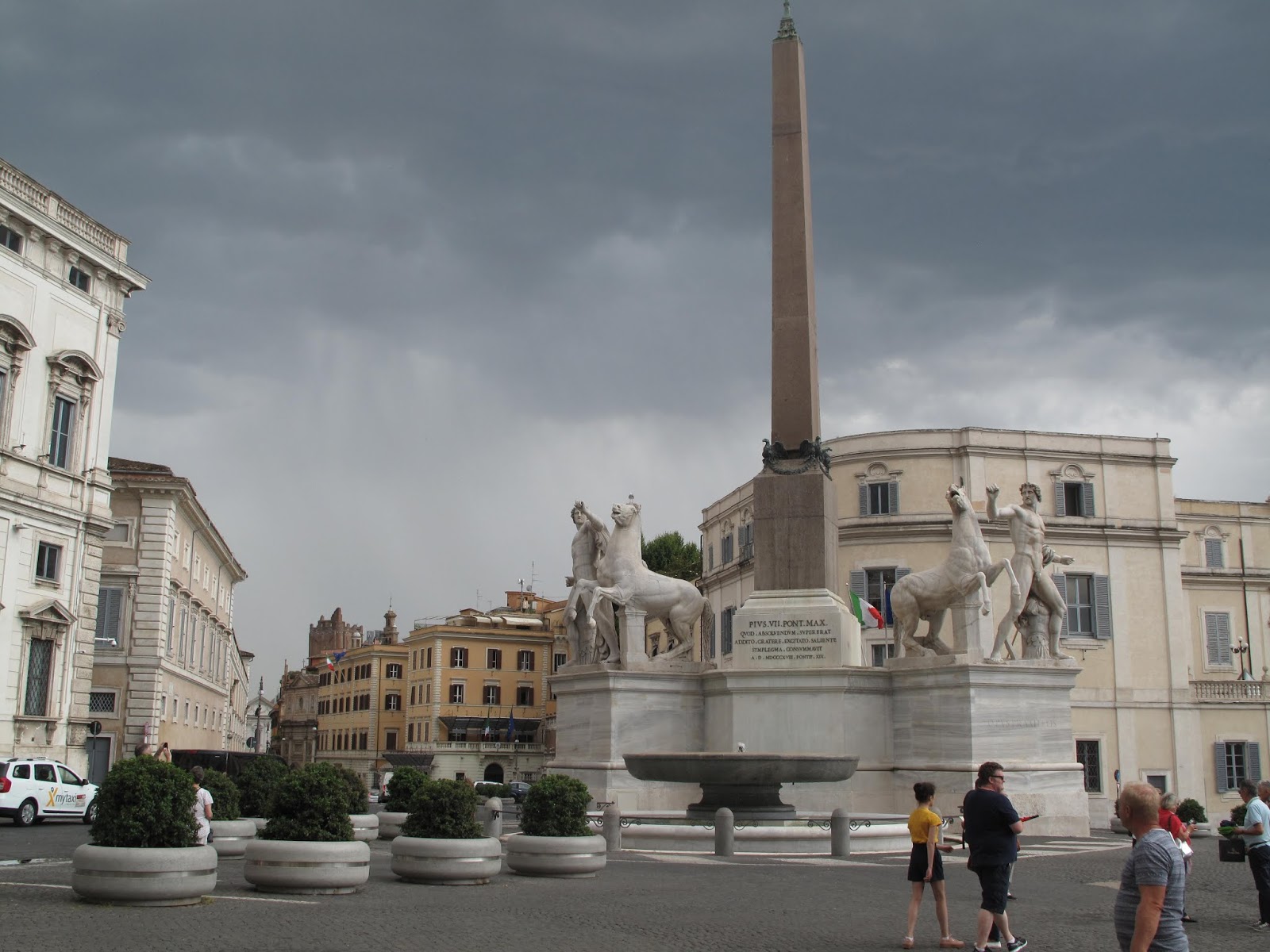
the square in front of the presidential palace, from which one has an expansive view over the city toward the west.  

Castor (or Pollux?) + horse, details from the statue group in the 

Piazza del Quirinale 


Heading downhill, we stopped for tea and some delicious almond cookies, just in time to avoid another downpour; and continued back to the hotel, via the Piazza Venezia and, not far beyond, the Largo Argentina and the little square with the delightful fountain.  


        Not bad for a day’s walk!


-------------------

More on the Turkish election results ... Some statistics that interested me:

        Recep Tayyip Erdoğan scored 52.6% nationally; his closest contender, Muharrem İnce, 30.6%.  Ankara province voted 51.5% for Erdoğan.  My district (ilçe), Çankaya, Ankara’s largest with 600,000 voters, went 64.4% for İnce, 23.6% for Erdoğan, but all other districts put Erdoğan first. 

        Aegean Turkey and Thrace favored İnce; the southeast preferred Selahattin Demirtaş, who was running his campaign from prison.  Virtually everywhere else, Erdoğan won.  Among Turks voting outside Turkey, Erdoğan won with 59.4%, İnce with 25.8%.  There are striking differences by country, though.  In western Europe, Erdoğan is very popular; elsewhere, not so much.  To take one example, in Germany, Erdoğan scored 64.8%, İnce 21.9%.  Turkish voters in Austria, Belgium, France, and the Netherlands  favored the president in similarly high numbers.  In contrast, Turks in the US (far fewer than in western Europe) voted 69.3% for İnce, 17.3% for Erdoğan.  This reflects social differences among the Turkish populations abroad – as indeed do the differences within Turkey itself. 

        The national participation rate was 86.2%.  People take voting very, very seriously.  In the US, so proud of its democracy, voter turnout in the 2016 presidential election was somewhere in the range of 55-60%.  Admirable for Turkey, pretty pathetic for America.  

Friday, June 22, 2018

Elections, Ankara's Jews, an Iron Age fortress, and lots of rain


        “Are you voting this Sunday?” the taxi driver asked.  The elections are major, both for the president and for the meclis (= parliament).

        “Yes,” I said.

        “Who are you voting for?”

        We were in a taxi en route to a reception at the British Institute of Archaeology (officially, the British Institute of Ankara), 24 Tahran Street, to bid farewell to the handsome building it has occupied for over 40 years.  The Institute is moving not too far away; at the end of the summer, when the books are unpacked and offices set up, we will have the chance to admire its new premises.  
British Institute at Ankara: 24 Tahran Street 

        
     The traffic was dense and barely moving. It had rained earlier in the afternoon, and the downpours flooded the underpasses.


        “This would never happen in America,” the driver said.

        “Well, yes, it can,” we said, thinking of the disasters of Katrina and Houston. “It’s true, though,” I added, “that Americans like to plan for medium and long-term contingencies.”  The driver seemed satisfied that his opinion was confirmed.

        We never made it to the reception.  We inched forward as far as the entrance to METU (Middle East Technical University) and, seeing wall-to-wall cars ahead of us, we decided to give up and turn back.

        I didn’t want to answer the question about my vote.  In Turkey today, you have to be very careful about what you say to whom.  A certain level of caution becomes automatic behavior.  Nonetheless, the driver teased an opinion out of me.  It turned out we were on the same wave length, so our conversation continued harmoniously. 

Recep Tayyip Erdoğan, President of Turkey


For the presidential race, there is good choice this time, as opposed to the previous election in 2014.  The main candidates opposing Recep Tayyip Erdoğan, the president, are three.  Muharrem İnce, the CHP (Republican People’s Party) candidate, center-left, is energetically holding rallies and matching the barbed rhetoric of the president with skill and humor.  

Muharrem İnce


Meral Akşener, the leader of the newly formed rightist nationalist İyi (Good) Party, was the first to announce her candidacy, fearlessly stepping forward to take on the seemingly unbeatable president.  And she is a woman.  

Selahattin Demirtaş, the candidate of the Kurdish-focused HDP (Peoples’ Democratic Party), is running from jail, where he has been held for over a year.  

All pledge to restore the balance of powers between the president, the parliament, and an independent judiciary.  Should Erdoğan win the election, the new system that grants the president significant power at the expense of parliament and other institutions will come into effect.

The taxi driver noted the wobbly economy, with its focus on construction instead of varied industrial production, and inflation. Indeed, with the free-fall of the Turkish lira against the dollar and the euro, prices of anything dependent on imports are shooting up.  Gas, for example -- so travel by car, bus, or plane and any products needing transport (virtually everything) will be more expensive. Today I read that onions and potatoes, the most basic and ordinary of food items, now cost well over 6 TL per kilo, four times more than one year ago. It may be too soon, though, for these price rises to affect the votes of loyal government supporters.  


        Last week, the holy month of Ramazan ended, followed by a three-day holiday. The campus was utterly quiet, a delight.  The World Cup began on the first day of the holiday, by sheer coincidence, also a delight. I do not follow football (soccer) normally, but every four years my dormant football-fan genes come to life and I watch as many matches as I can.  

Turkey and the USA didn’t qualify, but France is in the tournament and it’s always a pleasure to watch players like Cristiano Ronaldo when they perform at their best.  It’s odd, though, to live through this curious mix of religion (Ramazan), sports (World Cup), and elections (presidential and parliamentary). 

        Earlier in the month we attended a screening of “Hermana,” a documentary about Ankara’s Jewish community made by Enver Arcak, a graduate of our Bilkent University Archaeology Department. 

In a mere 30 minutes, the film recounts the history of the community and, through interviews with Jews who grew up here, people now living in Istanbul or Israel, gives a look at the texture of their daily lives and shows the fondness the emigrants retain for this city. “Hermana” means “sister” in Ladino, the Spanish used by Jewish people who came to Istanbul and Thessaloniki after being expelled from the Iberian peninsula in 1492.  In Ankara during the Republic (1920s on), this language began to be lost in favor of Turkish. 

Enver Arcak and one of the interviewees inspect a photo album


The interviewees are at ease in front of the camera, and project good humor as well as dignity -- a testimony to Enver’s skills in relating to people. He noted in the discussion after the screening how difficult it had been to find people to interview and then, as a non-Jew, to gain their trust.  He succeeded wonderfully.  We look forward to more films from him.


        Even earlier, in late May, Marie-Henriette and I joined a Friends of ARIT day trip to Çevre Kale, an Iron Age fortress located at Yaraşlı, near Kulu, 100 km south of Ankara. Geoffrey and Françoise Summers led the trip. They had surveyed the site in 1991, and recently, Geoffrey, together with N. Pınar Özgüner, published a reexamination of the site. 

Geoff Summers explains the site


        The fortress lies on a bluff above the plain, below Karacadağ, a small mountain. It has not been excavated, but the lines of the walls are clear. 

The view toward the south and east is commanding.  The fort is dated to the 7th-6th centuries BC, but abundant Hittite potsherds lying on the ground suggest the site was used by the Hittites as well, in the later 2nd millennium BC. 


        The morning was rainy as we walked up from the village to the site. The sun came out just as we sat down for our picnic lunch and stayed out the rest of the afternoon.  The hike around the site was glorious: the views, the hills, the clean air, the quiet.  I did not put on sunscreen or my cap, though, and that evening my face was bright red from the sun burn.  It took me several days to recover. 


        On the way back we stopped for tea at a large cafeteria-market at the crossroads where the north-south Ankara-Aksaray-Adana crosses the east-west road to Konya.  A huge thunderstorm let loose, with torrential rain and hail. I was drinking tea outside, but the canvas awning was not protection enough.  I was getting wet and hail was plopping into my tea.  I raced inside, getting wet even in those few instants, to wait out the storm before getting back into our bus. 

        We archaeologists who live in Ankara enjoy saying in late spring, year after year, with each tremendous outburst of thunder, lightning, and drenching rainfall, how well we understand why the Hittites had a storm god. 

        A Turkish colleague loves to say, “Summer does not begin in Ankara until July 1st.”  How right he is!  We have one week to go. 


Thursday, June 7, 2018

Ramazan, ID cards, and voting


            It’s Ramazan (Turkish for Ramadan), the Islamic month of day-time fasting.  I’m not Muslim, but even so, there are benefits. We eat Ramazan pide, the special bread of the season, and I enjoy güllaç, a glutinous milk-based dessert served only at this time.  Two Fridays ago we were invited by friends to a restaurant for iftar, the evening meal that breaks the fast.  The restaurant specializes in döner, meat cooked on a vertical spit.  We arrived 20 minutes early, but the restaurant was already full with families, seated at tables provided with a plate of dates and olives – the first things a fast breaker eats – and bowls of chopped tomato and cucumber salad, and shredded onions with parsley and sumac.  Waiters took our orders, and brought over a trolley of drinks (non-alcoholic).  We were seated under a large TV screen, which duly noted the iftar times throughout Turkey. There is almost a one-hour time difference between the east and the west.  Eventually Ankara’s time came, 8:12 pm, heralded with the call to prayer, and everyone started eating.  The waiters quickly and adeptly brought food to the many tables; getting food to all in short order requires skillful organization on the part of the restaurant.  We had lentil soup, then our plates of döner, and, for dessert, kedayif, the restaurant’s specialty, all delicious.  The four of us chatted away, eating in leisurely fashion; by the time we finished, the restaurant was empty.  The evening was balmy, so a stroll through the neighborhood was in order.

            At a corner nut shop I bought small portions of mixed nuts and salted peanuts at a nut to take home.  Turkey is a “kuru yemiş” (“dried fruit and nuts”) country, where excellent nuts are sold everywhere: walnuts, almonds, hazelnuts, pistachios, cashews, and peanuts, as well as leblebi (dried roasted chickpeas).  [France, in contrast, is not such a country.]  My non-Turkish appearance inspired the man at the cash register to speak to me in English. Because I have lived here so long, I don’t feel particularly foreign and have found it irritating when people speak to me in halting English.  Why are they singling me out?  Now, though, I’m less bothered.  If they want to practice English, why not? 

            In government offices, though, I would welcome attempts to speak English.  It might relieve the tension.  You wait and wait (these days with a printed number for your place in line, fortunately) and then you have to speak and reply with a certain precision.  You don’t want to blow it. 

A few weeks ago I was applying for a new ID card.  I came prepared with my biometric photo and, of course, my current ID card.  I arrived at the Public Registration Office (Nüfus Müdürlüğü) at 10:30 am and took my number. Fifty people were ahead of me.  I had nothing to read and, moreover, I had a lunch appointment.  I gave up and left. 

I discussed the matter with our secretary.  “You need to get there at 8:30 am, when the office opens,” she said.  “At the latest.”

Two days later, I got going early and arrived at 8:20 am.  This time I brought a folder of student papers to read.  Several people were already waiting, sitting in a long corridor outside the offices.  At 8:30 am, the office door opened and we filed in to get our automatic number.  Only 17 people were ahead of me.  Three counters were open, so the wait shouldn’t be too bad.  While I was perusing the announcements posted above the number machine, it suddenly hit me that I couldn’t pay the fee in cash.  It wasn’t much, only 18.5 liras (= $4), but I needed to pay it in advance, either on-line or at a bank.  I double-checked with the man ahead of me in line, no. 17. It’s true, he said.  Panic! Where would I find a bank?  I would lose my place in line and have to start all over! 

I remembered seeing a hotel just across the street. They would surely know where I could find a bank. Fortunately, banks were clustered nearby.  But the banks didn’t open til 9:00 am and it was only 8:45.  Nothing to be done; I had to wait.  Eventually, receipt in hand, I returned to the Public Registration Office where, miraculously, my number hadn’t yet been called. The man just ahead of me, no. 17, was at one of the counters.  I had to wait only five minutes and then it was my turn.  Registering fingerprints for all ten fingers took some time, as each finger had to be pressed and rolled onto a little machine at least three times, but the woman doing this, who was doing this all day long, was remarkably patient.  I told her so and she smiled.  The entire procedure was finished in 15 minutes, and early the following week my new biometric ID card was delivered to me in person, at home.

One reason I applied for a new ID card was because I read in “Hürriyet,” a major newspaper, that ID cards more than ten years old would not be accepted as proof of identity at voting stations on June 24.  The nation-wide elections for president and parliament taking place then are, needless to say, of major importance.  It would be a shame to be turned away because of an out-of-date ID card.

Two students who expected to be working at an excavation north of Rome just showed up at my office to say they couldn’t get an Italian visa. 

“What happened?” I asked. 

In order to vote in advance, before going to Italy, they applied at the Public  Registration Office for a dispensation. This was granted, and the two students went to Ankara’s Esenboğa airport and duly cast their absentee ballots.  However, the Public  Registration Office had changed their place of residence to Italy.  The Italian Embassy then said, We can’t give you a visa here, because you are not residing in Ankara but in Italy.  You will have to present your documents in Italy.  
A dilemma.  

“At least you have voted,” I said. 

“Yes,” they said.  “At least we have voted.”

Somehow I don’t think it was much of a consolation.

Tuesday, August 1, 2017

A mid-summer stroll in Ulus and a day trip to Kaman (Japanese Institute of Anatolian Archaeology)


        August 1st, the midpoint of summer.  It has been hot here in Ankara, and despite a cooler weekend, the result of a huge storm in Istanbul last week, hot days are predicted to return.

A nap in Ulus


        I was in Ulus last Wednesday, in particular to pay the semi-annual car tax.  An electronic panel registered the noonday temperature as 38 C (= 100 F).  As my last stop I headed for the huge covered market, looking for vişne (sour cherries), to make vishnovka, a Russian sour cherry vodka. Vişne are hard to find at our local markets; they are not for eating like sweet cherries, but are used in cooking, for jams and for fruit juice, all fabulous.  I also bought one kilo of apricots from Iğdır (impossible to explain in English how this name is pronounced), a province in far eastern Turkey, famous for its apricots and for Mt. Ararat.  The greengrocer gave me one to try: sweet, succulent, sublime.

        The Ulus district is entirely different from Bilkent, where I live.  It’s traditional Turkey, for people with modest incomes and a conservative bent, with little shops of all sorts and the city’s religious epicenter, the 15th-century Hacı Bayram Mosque. 

Sign: "This street goes to the Hacı Bayram Mosque"


But Ulus has an interestingly complex texture.  As the heart of ancient, medieval, and pre-Republican Ankara, Ulus has Roman ruins (the Temple of Augustus and Roma),

Temple of Augustus and Roma


Seljuk mosques (of which the Arslanhane Mosque is the greatest),

Inside the Arslanhane Mosque


Ottoman buildings (the Museum of Anatolian Civilizations is located in a restored han, or commercial building, of the 15th century), imposing government and bank buildings of the late 19th-early 20th centuries, the much-treasured early parliament buildings of the Republic, and now an impressive cluster of museums. 
Sign: "History comes alive again in Ankara!"


I bring my Byzantine & Islamic Art & Archaeology students here in November, for a half-day walking tour, in and around the medieval citadel, but that route has been set for years. Only if I am by myself can I see the city freshly.

Ankara citadel: Byzantine fortifications


        Is Ankara a great city?  I don’t usually think so, but walking around Ulus makes me wonder.  I’ll take up the issue with you later, after I finish reading Alexander Garvin’s recent book, What Makes a Great City.  Garvin doesn’t discuss examples from Turkey, though, not even Istanbul.  Instead, he concentrates on public spaces in European and North American cities.  Nonetheless, his insights deserve the attention of those interested in the pros and cons of Turkish cities. 

So-called Column of Julian (later 4th century), in Ulus


        Driving back from Kaman a few weeks ago, we noted that the posted population of Ankara is now just short of 5 ½ million.  That’s incredible.  I remember the city from the 1970s, with a population of a mere one and a half million.  The character of the city still seems to me pretty much the same, even with intense traffic, sprawl in all directions, sporadic clusters of high-rise office and apartment buildings, and a handsome airport.

        Kaman, a city of some 30,000 a two-hour drive southeast of Ankara, is notable in archaeological circles for the multi-period site of Kalehöyük (under excavation since 1985) and, nearby, the Japanese Institute of Anatolian Archaeology (founded in 1998), an archaeological museum, and a Japanese garden.  The museum and the garden are open to the public. 

Inside the Kaman-Kalehöyük Museum


Although Kaman is not far from Ankara, driving there gives you the feeling of going to a very remote place.  After turning east off the main north-south Ankara-Adana highway, the countryside starts to empty.  Towns, such as there are, are off the main road.  Indeed, our archaeobotanist colleague whom we would see at the Japanese Institute told us the land is not particularly fertile, accentuated by the deforestation of recent times (late Ottoman into the Republic).   For agriculture, government subsidies are needed.

        We did note a new feature as we drove along: at least three mescit, or Muslim chapels, next to the road.  In the old days, if someone wanted to pray in a remote spot, he stopped his car on the side of the road, got out, and prayed, using a little prayer rug if he happened to have one. 

One of the new mescit / chapels bore a prominent dedication to the martyrs of 15 July, those who died during the attempted coup d’état last year.  July 15, whose anniversary was recently commemorated, is being held up as the heroic moment in Turkey’s recent history.  The Atatürk Boulevard entrance to the Meclis in Ankara, the Parliament, is now marked by one-meter high blood-red blocks that say: 15 Temmuz Destanı (the July 15th Epic). 
A commemorative poster, 

which makes the art historian me think of:


        We crossed the Kızılırmak, the longest river in Central Anatolia, at a point used for centuries for fording the river.  Above a 13th-century Seljuk bridge is a promontory which the Hittites used as a fortress.  This is the site of Büklükale, under excavation by the Japanese Institute. 

View from Büklükale down toward the Kızılırmak River, with the

Seljuk (lower) and modern (upper) bridges


        I had forgotten to buy water before setting out from Ankara and before long I was getting thirsty.  There was nowhere to stop, though, without driving off the main road into one of the small towns in the area.  Eventually I saw a sign, Büfe/Market, and we pulled over.  I went in, took three small bottles of water from the refrigerator, and asked the older man on duty, “Ne kadar?”  (“How much?”).  He look at me ... paused ... then said, “Two liras.”  I paid, thanked him, went out.  I thought, that’s not right.  Two liras divided by three; what would the price per bottle be?  Normally, one pays 50 kuruş ( ½ lira) for a small bottle, or perhaps 75 kuruş or even one lira in the city.  But not two liras for three.  A tiny rip-off, but a rip-off nonetheless.  A suprise, for these days, now that the taxi stand at AŞTİ, Ankara’s central bus station, has cleaned up its act, the only place I might expect such behavior would be the top touristic districts in Istanbul.

        Eventually we reached Kaman, and soon after, the road for the Japanese Institute.  You can find the Institute's web site at: 
http://www.jiaa-kaman.org/en/index.html
The Institute is a magnificent facility, offering space for processing, conserving, analyzing, and storing finds from the three excavations and a surface survey that the Institute runs during the temperate months.  The projects are run in sequence: Büklükale first, Kaman-Kalehöyük second, third Yassıhöyük (located to the east, not far away), and, fourth and last, the regional survey.  Our visit fell between the first two projects, so there weren’t many people around.  But we had come to visit an Australian archaeobotanist who studies plant specimens from Kinet Höyük as well as from Kalehöyük, and we greeted Kimiyoshi Matsumura, the director of the Büklükale excavations, and two Bilkent MA students analyzing Iron Age ceramics from the excavations at Yassıhöyük. 
Autumn at the Japanese garden, Kaman


We had tea, and we visited the flotation machine (a series of large barrels with water and sieves, designed to recover seeds and other plant remains from soil samples) in the shelter of trees a few minutes’ walk away.  The lively conversation continued during a nice lunch.  After lunch, we were given a tour of the laboratories, study spaces, library, the grand lecture hall, and the storerooms.  It’s a place devoted to archaeology; clearly there is no time to do anything else.  And it’s a great testimony to the vision of the Institute director, Sachihiro Omura, and his wife and fellow archaeologist, Masako Omura.  May the Institute long prosper!


Monday, May 1, 2017

May Day: a holiday, cuisine, elections, proverbs, and homage to the late John Freely


           Today is Monday, May 1st, a national holiday in Turkey.  It’s pleasantly warm here in Ankara, but cloudy and rather muggy, and indeed the predicted thunderstorm has just burst forth.  For my university, this is the first break since classes began last February 6.  I felt a huge relief.  A three-day weekend, at last!  My fellow staff members, not to mention the students, surely feel the same.  

            I profited from the extra time by making a nice dinner yesterday evening.  Included was “siyez bulguru,” which I was preparing for the first time.  “Siyez bulguru” is “einkorn,” a very old form of domesticated wheat, dating even back to the Neolithic period thousands of years ago.  I bought some in Kastamonu, a city four hours by car north of Ankara, during a trip last November.  I was looking for wild mushrooms, a local delicacy, but a shopkeeper told me that because the autumn had been dry, mushrooms were scarce.  Would I not like to try this other local specialty?  I followed the recipe on the sack.  As for regular bulgur, you sauté an onion in butter and vegetable oil, add some tomato paste, water / bouillon, salt, red pepper, and the dark red-brown siyez grains, cook the mixture for 15-20 minutes until the water is absorbed, and then let the grains sit for 15 minutes.  Delicious: a chewy texture, but with a very nice flavor.  For an archaeologist, the chance to eat this grain which you usually only read about in textbooks was very exciting. 

* * * * * * * * * * * * * * *

It has been quite a year for elections.  Brexit, Trump vs. Clinton, the Dutch elections in March, the referendum here in Turkey on April 16, and now the French elections (Round One over; Round Two this coming weekend).  It’s emotionally draining, even if you don’t have the right to vote in a particular country and are watching from over the fence.  If your side loses, it can be a shock.  Here in Turkey, the result of the referendum on proposed changes to the constitution was close: 51.4% for, 48.6% against.  The “no” position did very well, considering the restrictions its proponents encountered when they tried to explain their views.  “Yes” took the conservative, pious, provincial heartland of the country, whereas “No” won in the biggest cities (Istanbul, Ankara, and, by a big margin, Izmir), the Mediterranean and Aegean coastal areas, Thrace, and in the southeast.  The Çankaya district in which I live, Ankara province’s largest with over 600,000 voters, went 78% “no.” 

The country is divided – but then so are the UK (with Brexit) and the US (with Trump) and, so it seems, France.  Reaching out to all, to losers as well as winners for national unity, seems not to be in the air these days.  It’s a winner-takes-all mentality.  Here, we are still living under Emergency Rule (recently renewed for another three months).  Yesterday, a new round of purges was announced: nearly 4,000 civil servants, including 400+ academics, were fired. That makes some 140,000 dismissed from state and private jobs since the attempted coup last July.  In addition, Wikipedia was blocked, because of (I am reading now in a report in today's “Hürriyet Daily News”) “two English language pages which claimed that Turkey channeled support to jihadists in Syria.”  The Turkish government has requested Wikipedia to remove these pages; until this is done, Wikipedia will remain blocked, even the Turkish-language version.  Wikipedia has been a godsend for teachers and students in particular.  How will we live without it?

One benefit from the referendum was a reacquaintance with the vast and colorful world of Turkish proverbs and sayings.  After complaints of irregularities in the referendum and cries for a recount, the president, refusing all protests, used the expression, “Atı alan Üsküdar’a geçti.” Literally “The one who took/stole the horse has already passed Üsküdar,” this means: “It is far too late now (to rectify it).”  This expression was new to me, but two Turkish friends with whom I was playing bridge the other day confirmed this was widely known. 

What other Turkish expressions use “at” (“horse”), I wondered?  I checked my Redhouse Turkish-English dictionary.  Lots, it turns out.  At random, I plucked out two, to test on my friends:

“Atın bahtsızı arabaya düşer.”  Ah, yes, they liked that.  Lit: It is an unlucky horse that has to pull a wagon.  Meaning: Some people do not get work suitable to their talents.

And one more: “Ata nal çakıldığını görmüş, kurbağa ayaklarını uzatmış.”  Lit: A frog saw them shoeing a horse and he stuck out his feet.   Meaning: He/She wants things he/she has no right to expect.  My friends didn’t know this one, but they burst out laughing, enjoying it.

* * * * * * * * * * * * * * *

I was sad to read of the recent death of John Freely, on April 20.  Freely (1926-2017) was a professor of Physics at Istanbul’s Boğaziçi University (aka Bosphorus University, formerly Robert College) and a prolific author of books on travel and history.  [Sadly, his biography on Wikipedia is blocked today in Turkey: “Hmm, we can’t reach this page.”]  I must have met him, at least in passing, although I don’t have a precise memory of having done so.  Nonetheless, he was a legend among Americans living in Turkey, for his long experience here and his love for the country, so I feel I knew him well.  When Marie-Henriette and I first spent a year in Istanbul, in 1974-75, Strolling through Istanbul, the guidebook he wrote together with Hilary Sumner-Boyd (orig. 1972, revised 2010), was our essential companion as we explored the old parts of the city.  I have just taken it off the shelf, and am leafing through it now.  What pleasure it gives!  The warm, friendly language; the level of detail; the privilege and joy of penetrating the secrets of this great city . . .  it’s still a truly marvelous book. 

Sunday, April 2, 2017

Extended break -- coming to an end?

I see with a shock that my last posting dates to August ... 2016.  An extended break, a hibernation longer than a bear would undertake in winter.  The result of priority given to other activities, many of them obligations (such as teaching)?  More likely, I just ran out of steam.

I now feel some stirrings.  Time to wake up, open the eyes, look around, watch, see; time to stretch and move.  Time to write again. 

It's spring, this first Sunday in April.  Spring has arrived early in Ankara this year, a surprise, considering how cold and snowy December and early January were.  Today the weather is glorious: sunny, not a cloud in the sky, a crystal clear view over the city to the mountains beyond, no haze whatsoever from dust or air pollution.  Temperature: a delightful 18 C / 65 F. 

Also encouraging: things accomplished recently, several at long last. I paid overdue car taxes at the tax office in Ulus.  No line, and a warm smile from the man behind the counter.  At the Kızılay metro station (now named the 15 Temmuz Kızılay Milli İrade İstasyonu / the "July 15th Kızılay National Will Station" -- honoring successful resistance to the attempted coup d'état of last July), I bought (for 5 TL / approx. US $1.50) my free pass for public transportation (buses and subways), a privilege Ankara offers its senior citizens.  My card, with photo, says in big letters: 65 YAŞ ("age 65").  A brutally frank reminder of passing years, but for free transportation, who's to complain?  And our ice box, which stopped cooling, is now repaired.  We have retrieved our frozen foods from a refrigerator in a guest apartment two floors down, and brought in everything else that we had temporarily stored on our balcony (nature's own refrigerator, at least in this season).

I have received my voter's card for the upcoming referendum on April 16, in which Turkish citizens will be asked to vote "Evet" ("Yes") or "Hayır" ("No") for changes to the constitution that strengthen substantially the powers of the president.  The push for Yes (the position of the president and of the ruling party) is seen in countless billboards across the city.  On my way to the Ulus tax office, I stopped counting at 30.  As for No, I saw nothing on my way to Ulus, but later, crossing the city, I noted one small bus parked boldly in the center of Kızılay, with a big Hayır ("No") on its side, and one banner hung between trees in Kuğulu Park, with the picture of a young girl and the slogan -- if I remember correctly -- "Geleceği için" ("For her future").  The publicity is definitely lopsided.  Does this mean a giant win for Yes on April 16?  Who knows?  We'll see.