Sunday, March 29, 2015

Insults, free speech, and Florence


How are we to distinguish criticism from insult from making fun of someone?  An eternal question.  In Turkey, the issue is deeply connected with paternalistic, patriarchal tradition: you don’t criticize your superiors (= your father), at least not in public.  Insulting Atatürk, the founding father of the Republic, has always been a crime, but these days, not everyone might be shocked if you tried it.  Insulting the current president, Recep Tayyip Erdoğan, is another matter altogether.  In recent months we have been watching person after person arrested, including teenagers, a former Miss Turkey, an “eccentric singer” (Atilla Taş) who declared on March 6, "It is an honor to be detained for my opinions, not for stealing or for corruption," and, this past week, two cartoonists whose cover of the Turkish satirical magazine “Penguen” insinuated (or so it was alleged) that Erdoğan is gay. 
You might think anyone who seeks public office should be prepared for criticism.  A thick skin is surely a must.  How does this square with the traditional Turkish view that the person at the top deserves unqualified respect?  Not easily.  But Erdoğan, who rarely restrains himself when commenting on his opponents, not only may have a thin skin, but also (one suspects) must enjoy the combat.
Free speech is a concept viewed with suspicion.  Although Prime Minister Ahmet Davutoğlu marched in Paris on January 11, with Hollande, Merkel, and others (including Netanyahu) in support of free speech, or at least against violent opposition to free speech, early this month the Turkish government blocked the internet site of “Charlie Hebdo,” among many other sites. Blasphemy was the justification.  The action brought “Charlie Hebdo” to our attention once again. 
                                                Near San Marco Square, Florence

One of the ironies of the murder of “Charlie Hebdo” cartoonists and staff on January 7 has been the huge publicity generated for this magazine. In the past, during trips to Paris, I had noted “Charlie Hebdo” at the newsstands, but I never bought a copy. Although it was well-known, its sales were low. Thanks to the attack, sales have soared. I myself promptly bought a book of cartoons by Cabu, one of the cartoonists killed. I had never heard of him, but now he is a household name.   


Peut-on encore rire de tout? [“Can we still laugh about everything?”] was published in 2012; the answer, seen in the cover cartoon, is a vehement “Non” [“No”] – sadly.  The cartoons satirize prominent people and institutions and notable happenings in France during the previous two years. Most targets are French political figures – such as Sarkozy, Hollande, Strauss-Kahn, Le Pen (father and daughter) – but indeed religious authorities and fanatics are caricatured, too: Christians and Jews as well as Muslims. For anyone familiar with the recent French political and social scene, the cartoons are hilarious.
 “Je suis Charlie” was in evidence in Florence, where I went for a short trip in mid-January. 


 Regional council chamber, in the Palazzo Medici-Riccardi

But “Charlie Hebdo” came up only briefly.   I was accompanying Marie-Henriette to a conference on Anatolian and Syrian ceramics of the Late Bronze Age, organized by the University of Florence.  The conference coincided with a major men’s fashion fair, “Pitti Uomo” – but my path crossed fashion only once.
               Fashion shoot, at the main door of Santa Maria Novella
 
Our previous visit was in 1979, when we spent a memorable week with a college classmate, a specialist in Italian Renaissance literature.  I knew little about the city, only the basics. This time, I came armed with knowledge from nearly 25 years of teaching Florentine art and architecture in a first-year undergraduate survey of art and architectural history.  I had a mental check list of things I wanted to see.  Buildings – because they are three-dimensional, their space is hard to comprehend from photographs – and frescoes in their architectural settings were the priorities.  I saw a lot.  Because tourists were relatively few, I could linger in front of masterpieces as long as I wanted.

Of the many wonderful things I saw here are five:
(1) A small chapel in the Palazzo Medici Riccardi with frescoes painted by Benozzo Gozzoli. I felt I was standing inside an exquisitely decorated box.  
                                          John VIII Palaiologos, Byzantine emperor,
                                     in Gozzoli's frescoes, Palazzo Medici-Riccardi

(2) Brunelleschi’s dome for the cathedral of Santa Maria del Fiore (the Duomo).  I climbed the 463 steps to the top, an aerobic adventure, to emerge onto a narrow ledge around the base of the lantern.  I was surely the oldest person up there.  The view was thrilling, but because it was a bit rainy, I wasn’t tempted to stay long. 
 View from the top of the dome.  To the left: the Campanile
 
PS, since insult is the theme of the day: I’m reading Ross King, Brunelleschi’s Dome. How a Renaissance Genius Reinvented Architecture (2000), and have learned that insults and counter-insults flew fast and furious in 15th century Florence. After the failure of Brunelleschi’s amphibious vehicle, “Il Badalone,” designed to carry huge loads of Carrara marble at a cheap price, Giovanni da Prato, a bitter rival, wrote a sonnet in which he called Brunelleschi “a pit of ignorance” and a “miserable beast and imbecile.” Brunelleschi responded in kind, labelling Giovanni a “ridiculous-looking beast.”  Criticisms, insults, and mockery became so vicious that the Florentine authorities made Brunelleschi and other citizens swear an oath to “forgive injuries, lay down all hatred, entirely free themselves of any faction and bias, and to attend only to the good and the honor and the greatness of the Republic, forgetting all offences received to this day through passions of party or faction or for any other reason.” (Ross 2000: 114-116).   
(3) The former convent of San Marco, now a museum, with frescoes notably by Fra Angelico.   


 Mary, as depicted by Fra Angelico

Upstairs, one sees the cells of the monks, each one decorated with a fresco of religious theme.  In the corridor at the top of the stairs is his “Annunciation,” justly famous.
 
"Annunciation" on the left

(4) Pontormo’s “Deposition from the Cross,” a glorious Mannerist painting, in the small Capponi Chapel in the church of Santa Felicità.  You had to put in a one-euro coin to get three minutes of light. On the adjacent wall is his “Annunciation,” which I didn’t know at all: a revelation.
                           Mary, in Pontormo's "Annunciation"
 
(5) The Pazzi Chapel, designed by Brunelleschi, attached to the large church of Santa Croce. I knew this from photographs, but I couldn’t understand its interest. Inside, the space, 3-armed and domed, swells and rises with amazing power.
                     My photos of the Pazzi Chapel didn't do it justice, so I offer instead 
                     this view of the nave of San Lorenzo, another Brunelleschi design.

As an archaeologist, I must add a sixth: (6) in the Archaeological Museum, the François Vase, a spectacular (and larger than expected) Attic black-figure vase made ca. 570 BC, the Chimera of Arezzo (an Etruscan bronze statue, ca. 400 BC), and the Egyptian collection, about which I knew nothing, room after room of a wonderful range of objects still in an old-fashioned display.  
 The François Vase
 
* A food highlight: a lunch with tagliere (lit. “cutting board”), a round wooden platter loaded with antipasti (= meze, appetizers) of a distinctly Florentine sort (crostini with artichoke, liver, and other patés; cold cuts; and cheese), arranged with artistic flair.
                                                             A Florentine market

** And the Arno River at sunset ... 


Sunday, November 2, 2014

A boxwood plant, a palace, a restaurant, and 18 miners


     Yesterday I drove north from Middle East Technical University to the garden stores that cluster not far from the huge Karşıyaka cemetery. I had killed the very nice boxwood (“şimşir”) on the terrace outside my office – I had failed to water it at some crucial time this summer, although I can’t reconstruct how this could have happened – so I was in search of a replacement.  As I headed north, I wondered, could I see the Ak Saray (“White Palace”), the colossal, extravagant palace built by Recep Tayyip Erdoğan, formerly prime minister now president, in the Atatürk Orman Ciftliği (AOÇ), the farmland given to the nation by Atatürk, land officially protected in 1992 from new construction?  Yes, I could!  There it was, dominating a distant hilltop.  
         Things have changed in the AOÇ.  I didn’t go there often, but it was always there as long as I have been in Ankara, a rustic park-cum-farm, with its dairy production (milk, yogurt, butter, important in the years before Pınar and other companies standardized and expanded this market), a zoo, snack bars, a beer factory, a small railway station, a garden shop, and a wonderful restaurant, the Merkez. Atatürk himself had dined here; the restaurant offered postcard photos of him, İsmet İnönü, and other dignitaries as tokens of that venerable past.  The building itself was plain, but in summertime, I loved having dinner in the garden amidst the trees.   
 

It was a glorious experience, relaxing yet dignified. The menu offered Chicken Kievski and Beef Stroganoff, staples of those old Republican restaurants founded in the 1920s and 1930s by White Russian emigrés.  Such restaurants are all too few in Ankara today.
The restaurant closed in 2013, allegedly because its rent was not paid.   

 Tarihi Merkez Lokantası Kapandı
Across the street was a garden shop, where I bought the now deceased boxwood and two rose bushes that continue to thrive on the balcony at home.  I imagine the garden shop has closed, too, the land on which both the garden shop and the restaurant stood now occupied by a portion of the new palace.  I didn’t have the heart to drive over there to check.  Who knows, I might have been stopped on the way by security guards, or not recognized where I was, had I even reached the spot.
The palace was to have been grandly opened this past October 29, Republic Day, the national holiday.  A few days earlier, though, flooding in a mine near Karaman trapped 18 miners.  They have yet to be rescued.  The country was reminded of the disastrous accident at a coal mine near Soma last May, which claimed the lives of  301 miners.  The Republic Day reception at the palace was cancelled, in recognition of this new tragedy.  How grossly indecent, many thought, to call attention to the vast palace, costing some $350 million, with its 1000 rooms, its tunnels and super secure bunkers when safety standards at mines, indeed at industrial and construction sites of all sorts, desperately need upgrading and strict enforcement. 

Monday, July 7, 2014

Brazil + Turkey = football and elections!


        I don’t usually follow football (= soccer), but every four years I come alive for the World Cup.  This year it's taking place in Brazil.  


These past weeks I’ve been watching regularly, since Turkish TV (TRT 1 and 2) is broadcasting every match at 7 pm and (the first round) 10 pm or (second round on) 11 pm, convenient after the work day is over.   

My teams are now either eliminated (USA & France) or never made it to the tournament in the first place (Turkey), so I can enjoy the final games with equanimity.  I’m sad to see Neymar out, though, for he was a pleasure to watch.  I wish him a speedy recovery from his broken vertebra.


        I’m learning a lot about the geography of Brazil.  Belo Horizonte, for example, is a city I had never heard of.  And I had no idea it takes 13 hours to drive from Sao Paolo to Brasilia.  The country is immense.   


I also thought of it as being flat (Atlantic beaches and Amazonian forests) but that’s a mistake. There are substantial highlands and even, in the extreme northwest along the border with Venezuela a mountain almost 3,000 meters high, the Pico de Neblina – almost always hidden in mist.  I never had much desire to visit Brazil, a country without the spectacular ruins of Mexico or Peru, but now I’m curious.  I shall look for a “Lonely Planet – Brazil” and explore the touristic possibilities.

        While the World Cup heads for its climax, we in Turkey are preparing for the first-ever direct election of a president, scheduled for August 10 and (if a run-off is needed) August 24. Heretofore, the President of Turkey has been elected by the Parliament.  Moreover, he (or she) should be non-partisan, and a steady rudder through political storms.  


        This description hardly conforms to the persona and ambition of the leading candidate, prime minister Recep Tayyip Erdoğan.  But he has long aspired to the presidency, we all know it, and this past Tuesday, July 1st, at a large gathering of AK Party faithful, he accepted his party’s nomination.

        Opponents include Ekmeleddin İhsanoğlu, 


a dignified, accomplished, professorial conservative running as an Independent (although backed by the main opposition parties), and Selahattin Demirtaş, representing Kurdish parties. Although İhsanoğlu should appeal to AK Party voters, his religious credentials being impeccable, at the moment most analysts think their loyalty to Erdoğan is unshakable.  

Ekmeleddin İhsanoğlu (left) visits Hacı Bektaş

        Should İhsanoğlu win, we can expect him to uphold the traditional role of the president.  Erdoğan, however, has already promised change.  He will not simply preside, but will rule.

        If Erdoğan is elected president, what role will the legislative branch, the parliament, exercise?  Will separation of powers (executive, legislative, and judicial) be finished?  No one knows. 

        But the election is not yet a done deal, and İhsanoğlu is beginning to speak out.  In an interview published in today’s Hürriyet Daily News, he advocates keeping religion separate from politics, and notes a widespread desire for peace, stability, and a change in the tenor of political discourse.  He will not be a doormat that Erdoğan can walk over easily.


        A ripped, shredded campaign poster still hangs off a lampost at the turn-off to our local shopping center, even though municipal elections were held at the end of March.  The forlorn poster is for Barış Aydın, a nice-looking young man who stood as the AK Party’s candidate as mayor of Çankaya, one of the central districts of Ankara.  But Barış Aydın was destined to lose, no matter how attractive the ads and posters, for Çankaya is a stronghold of the center-left CHP (Republican People’s Party), the party founded by Atatürk.
        Although Erdoğan’s AK Party, which rules in Parliament, just squeaked by in Ankara overall, in the Çankaya district, its over 500,000 voters went 65% for Alper Taşdelen, the candidate of the CHP.  Barış Aydın received 22%.  I trust the AK Party has rewarded him for gamely accepting this sacrificial role.


Tuesday, June 24, 2014

Ankara swim, Chaco Canyon, and Signs


            One of my great joys of summer in Ankara is swimming in the outdoor pool at Sports International, my local fitness center.   


The pools (there are two) are open from early June til late September.  Because of a trip to the US (see below) and a recently diagnosed partially ruptured Achilles tendon, I couldn’t go until yesterday. 
I showed my membership card to the young man at the desk.
        “Your membership has expired,” he said.
        What?  No one told me.”
        “They telephoned you.  On May 9th.”
        “I was here!  Why didn’t they try again?”
        “I don’t know.”
“I’ll swim first, then go renew.”
“No!  You can’t swim!”

There was nothing to do but hobble (with my sore tendon) over to the main building, renew my membership, and hobble back to the pool building.  This time I was welcomed and the swim, with almost no one in the pool Monday lunchtime, was indeed glorious

Sports International sports a great array of signs, mostly warnings, cautions, and prohibitions.  Their number has increased over the years.  I normally pay them no attention, but yesterday, perhaps the result of that challenge at the reception desk, they rose up and angrily confronted me.

No smoking!

No food or drink in the pool area!

No diving into the pool!

Worthy members, please do not leave valuables in your car!  Thank you.

No parking!
Slippery floor!
        Staff only!

I recommend they add a sign I saw earlier this month in the garden of the Alderbrook Inn, halfway around the world on the Hood Canal (near Seattle):
 

        My Sports International favorites, though, are in the men’s locker room in the main building: DO NOT WALK NAKED and the poster with Michelangelo’s David  draped with a towel.


Its Turkish legend roughly translates as follows:

“Towel Culture.  The ancient Greeks walked around naked in the baths.  But that was in the 700s BC.  As for us, in public areas, let’s follow up-to-date rules and use a towel.”

        Non-Turkish readers will understand, I’m sure, that the Turkish male has a highly developed sense of modesty.  


        The outdoor pools (there are two) open in early June.  I couldn’t go earlier, because Marie-Henriette and I traveled to the US for tourism and a family visit.  The touristic part included a visit to Chaco Canyon, a spectacular archaeological site in remote northwestern New Mexico.  To get there, you have to drive over dirt roads the final 20 miles (32 km), a deliberate strategy on the part of the government to keep crowds away.  Once there, the national park (Chaco Culture National Historical Park) does have a paved road that gives access to a visitors’ center and to the main ruins.

The ruins at Chaco Canyon, excavated especially from the late 19th c. through the 1930s, consist of “great houses,” smaller settlements, and kivas (ceremonial areas) built by the ancestors of today’s Pueblo, Navajo, and Hopi peoples in the 9th-13th centuries AD.  The great houses are huge: over 600 rooms (at the largest, Pueblo Bonito), multi-storied, and built with amazing stone masonry.  The finds – pottery, turquoise jewelry, etc. – are stunning.

        Why did people settle here?  Over the decades, interpretations have changed.  Early explorers believed the canyon was a locus of heavily populated villages.  Now, the great houses are understood as ceremonial centers used only for specific events.  People would come from afar, staying only temporarily.

        This interpretation will remind the reader familiar with ancient Turkey of Göbekli Tepe, the sensational ceremonial site in the southeast, not far from Şanlıurfa.  

Göbekli Tepe consists of stone-walled, round buildings, sometimes containing relief sculptures of people (stylized), vultures, scorpions, and predatory animals, startling images of unknown meaning.   The architecture recalls the kivas of Chaco Canyon and the surrounding region.  Like Chaco Canyon, Göbekli Tepe is thought to be a ceremonial center, revered by people coming from a large radius.  But the time difference between the two sites is huge: Göbekli Tepe, assigned to the earliest Neolithic period, is dated by Klaus Schmidt, the director of excavations, to the 10th-9th millennia BC.  Any correspondences must be coincidental, even if each may reflect a similar social dynamic. 

        Sign at Chaco Canyon: not so different from signs at Sports International (even if SI has yet to be recognized as a sacred site).  Göbekli Tepe is not yet so well organized for visitors, but no doubt in a few years it will be.


Thursday, March 27, 2014

Spring cleaning


            The other day I came across Uğur Bey, our photocopy man, relining a desk drawer with some heavy paper.
        “Spring cleaning,” he said.  It looked neat and tidy. 
“I need to do the same,” I said, “for my whole office.”  A Herculean task, I’m afraid, thanks to my congenital disinclination to order and the lingering effects of last summer’s renovations in our Faculty building (plaster dust, books & notes stashed randomly).  

        One Monday morning in early February, I returned to my office from ten days in England, a visit with some lectures to give at the University of Reading, courtesy of the Erasmus staff exchange agreement between our Archaeology Departments.  Our spring semester was already underway.  My wastepaper baskets were full.  The croton on my desk, its leaves drooping, was dying of thirst.  Murat, our cleaning man, had not once set foot in my office, it was all too clear. 

        Looking on the computer, I learned that one of my courses – introduction to European art and architecture, medieval to modern – was scheduled in a classroom without a projector.  Another course had been assigned no room at all. 
        “The rooms are all taken!” was our secretary’s immediate reaction.
        By the late afternoon, the waste baskets had been emptied, the carpet vacuumed, the croton watered, and the two courses had been scheduled in a classroom (with projector) right next to my office. 

        Murat is well-meaning but cleaning is not his forte.  Three young colleagues from the Pyschology Department, newly arrived last September and installed in offices on our Archaeology corridor, finally gave up on him and arranged for the janitor from Psychology’s heartland, two floors up, to come down and clean their offices.  This man appears daily, with a cart well-equipped with trash bags, cloths, sponges, and cleaning products.
        We archaeologists suddenly took notice.  Why were we accepting shoddy cleaning?  But now, surely Murat would be inspired by his colleague’s example, procure proper equipment, and empty our trash daily – wouldn’t he?
        A few weeks passed and nothing changed.
        Fed up, we demanded that our chair speak with Esat Bey, the supervisor.  Esat Bey once came on an Archaeology Department field trip to Hattusa, the Hittite capital – we know him well.
        The next day, Esat Bey made the rounds, speaking with each colleague.
        I ran into Murat and Esat Bey in the corridor.
        “If he doesn’t clean regularly,” Esat Bey said, “we’re going to fire him.  How often does he empty your trash?”
        “Once every ten days,” I said.
        Esat Bey gave Murat his orders.  Murat smiled.  They have known each other for a long time.
        My trash is now emptied daily, more or less, my office vacuumed and the desk wiped regularly, more or less – with water splashed on the carpet, routinely.  The water splotches are a sign that a cleaning activity has taken place.
        It’s now up to me to do my share – to put on a CD (Cesaria Evora is particularly inspiring) and ruthlessly sort, throw out, arrange, organize.

        At home, our cat is shedding, now that winter has given way to spring.  Momtaz is a long-haired Persian, so there is much fur to shed.  A daily brushing is in order, by her personal groomer (Marie-Henriette or me), which she enjoys enormously.

        This Sunday we’re having nation-wide elections, for municipal offices.  Will this be an electoral spring cleaning?  The prime minister has framed these elections as a referendum about himself, although he is not a candidate. In the two largest cities, Istanbul and Ankara, the races are tight between the incumbents, both AK Party (the prime minister’s conservative Islamist party, which holds a majority in Parliament), and the main challengers, both CHP (Republican People’s Party, the main left-center party founded by Atatürk).
        Melih Gökçek has been the mayor of Ankara for 20 years.  His mustachioed face is very familiar.  To him we owe a Piranesian network of underpasses and overpasses, no doubt helpful for traffic flow but contributing nothing to the visual elegance of the city.  To think that Ankara could have had its own Champs Elysées, if only the urban planning principles of the 1930s had been stuck to!
        To boost the mayor’s prospects for reelection, the new metro line to Bilkent and beyond, westward along the Eskişehir road, was opened just two weeks ago, after at least a dozen years under construction.  The prime minister joined the mayor at the official opening ceremony.  
We rode the new metro to Kızılay the other evening.  It is great, we all agree, but is opening it now, just before the elections, going to change anyone’s vote?  


As one of the numerous AK Party campaing posters notes, “I’ll look at accomplishments, not empty words” (“Lafa değil, icraata bakarım”).  Many voters might be doing exactly that, although (in light of the corruption scandal ongoing since December 17th) not in the way the AK Party intends.


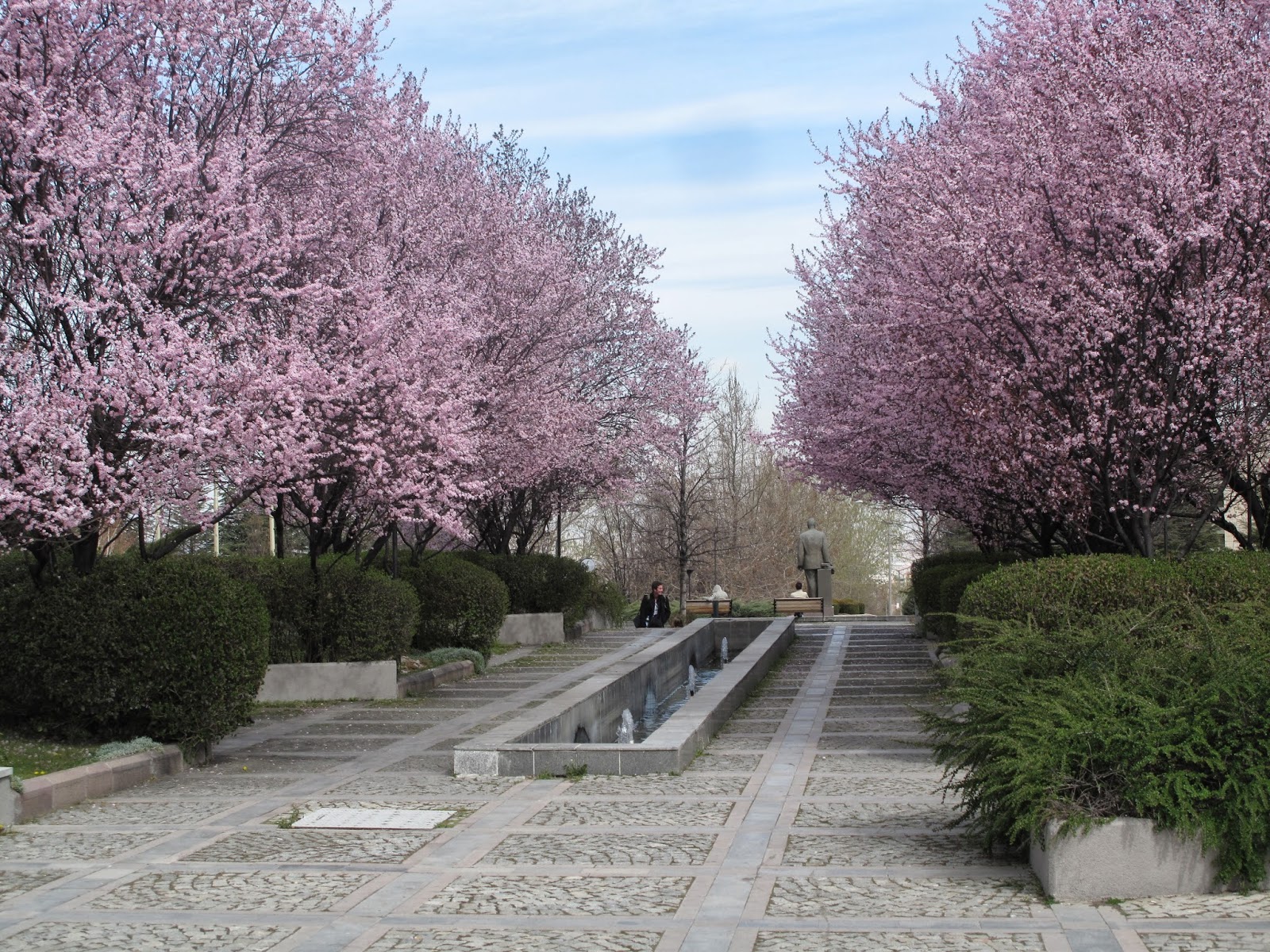
Meanwhile, the fruit trees on the Bilkent campus are in full, magnificent flower. 
Spring is here.