Wednesday, July 14, 2021

Meeting in a playground + Fred's Bread (Ankara Style)


         Today is Bastille Day, July 14!  Salutations to France and to all French and Francophile readers.


14 TEMMUZ 2021: FRANSIZ ULUSAL BAYRAMI KUTLU OLSUN! 

14 JUILLET 2021 : BONNE FÊTE NATIONALE !


         Here in Turkey we’re heading into an extended holiday period.  Tomorrow, July 15, is Democracy and National Unity Day, the country’s newest holiday, remembering the overcoming of the attempted coup d’état five years ago.  


Next week comes a major Muslim holiday, the Feast of the Sacrifice (Kurban Bayramı, more and more frequently called by its Arabic name, Eid al-Adha).  This holiday will last 4 ½ days, Monday afternoon (the eve of the holiday) and Tuesday through Friday (the actual holiday).  As you can imagine, the government has declared Monday morning a holiday, too, thereby creating a holiday of nine days, if one counts the weekends on either side.  And who will be working this Friday, July 16?  Many will be taking that day off, too.   

         Crowds of people from Istanbul and interior cities are expected to head toward the Aegean seaside resorts.  The traffic will be horrendous!  And what about the beaches in this time of Covid?  I shudder to think. 

         For those of us staying put, the holiday means no mail service and no office support.  But the campus will be delightfully quiet and peaceful.

* * * * * * * * * *

         We’re definitely in summer now, with sunny, clear, and dry days. So far, not too hot, but temperatures are predicted to jump this weekend to 99 F (37 C).  Time to get out the electric fans. 

         Summer was late in coming.  Til the end of June we had frequent thunderstorms and rain.   This isn’t unusual.    The storms are typical for Ankara in May and June – no complaints about rain, by the way.  As an Ankara friend once told me, summer never really begins in Ankara until July.  For the moment, the campus is green.  Wildflowers abound; the frogs in the drainage ditch by the Middle Campus are croaking away.  I even saw a fox the other morning, light-colored with a bushy tail, emerging from trees and bushes and racing across the road. 

* * * * * * * * * *

One month ago, in full thunderstorm season, we attended an official dernek meeting in the city.  Dernek is Turkish for an association, society, or club.  The government, no matter which party in control, has always been suspicious of derneks as possible hotbeds of subversive activity, so there are detailed regulations about their organization, officers, membership, finances, and activities.  In recent memory, the screws were severely tightened after the coup d’état of 1980.  The rules have relaxed, but nonetheless, they must be followed.  This particular dernek holds a formal board meeting every three years, no longer with a government representative in attendance, but with an agenda strictly observed and a report submitted to the government.

Because of Covid-19 restrictions, we couldn’t meet indoors.  In fact, the meeting had been officially postponed, in the hope that we eventually could.  That proved not possible, so the government approved a meeting outdoors, with masks, social distancing, etc.  We gathered in the playground of the Basın Şehitleri Park, in Çankaya.  Basın Şehitleri, “press martyrs,” refers to journalists who have been killed. This is a professional risk for journalists everywhere, but Turkey has had prominent examples, notably Uğur Mumcu, a high-profile investigative journalist who worked for the center-left newspaper, Cumhuriyet.  He was killed by a car bomb in 1993. 


In the playground, under menacingly dark clouds, we held our meeting.  The rules were followed scrupulously.  Participants signed the list, to indicate that the necessary quorum of members was present.  We stood for one minute in silence in homage to Mustafa Kemal Atatürk, the founder of the Republic of Turkey.  The meeting continued with formal reports on finances and activities.  The floor was then opened for comments and suggestions about future projects.  After one hour, we were finished.


Since most of us knew each other, we took great pleasure in being able to get together, even with masks (removed for drinking tea or coffee and eating cookies, both sweet and savory in the Turkish manner), exchanging greetings and news of what we had been doing these past months.  How nice it was!

* * * * * * * * * *

Outside our apartment are two black mulberry (Turkish: karadut) bushes, or small trees.  These past weeks, both have been abundantly producing ripe berries.  Although they stand only 3 meters apart, one yields delicious fruit of the highest quality, whereas the other is merely good.  Why the difference?  I have no idea.   Sunlight, soil, and water are surely the same. 


The top quality bush has developed a reputation.  People whom I have never seen before, even children, come by, inspect, and help themselves.  Because this bush is just outside the building where I live, I feel a certain proprietary sense.  This bush is ours!  These berries are mine!   But share I must, and I try to feel joyful that this bush and its companion are giving pleasure to many.  

* * * * * * * * * *

One of the things I have been doing during this pandemic is making bread.  My favorite store-bought bread in Ankara is the “rustik ekmek” (country bread) sold at Çağdaş market in the Kent Park shopping center.  It’s a dark sourdough bread, and I find it fabulous.  But I haven’t set foot in this shopping center since March, 2020, and instead began to explore other possibilities.  Our local Meteksan market sells a variety of flours, normal and organic.  I have been buying basic white (in Turkey, this is made from durum wheat); whole wheat; rye; oat; corn (= corn meal); “German mountaineer’s mix” (Alman Dağcı Karışımı), which is a mix of dinkel wheat (= spelt, an ancient form of wheat) with seeds and sourdough; and einkorn (Turkish siyez), one of the earliest cultivated wheats, now a rarity from Kastamonu province used for bulgur and bread.  It has a wonderful rich, hearty flavor.  I have been mixing these flours in different proportions, getting different results, all delicious.


The recipe I now favor is a modification of one given to me in the late 1980s by Fred Williams, a student of Classical and Near Eastern archaeology at the University of North Carolina—Chapel Hill.  I have no idea what happened to Fred, but his recipe for bread has served me well.  Here it is, in case you would like to try it. This will make two loaves.


Fred’s Bread (Ankara Style)

Ingredients (American measurements, with metric equivalents)

2 cups (500 ml) regular white flour, suitable for bread.

1/2 cup (125 ml) or 1 cup (250 ml) corn meal. 

3 1/2 cups (875 ml) – if 1/2 cup corn meal used; or 3 cups (750 ml) -- if 1 cup corn meal used: a mix of your choice, any proportions, of any of the following flours: whole wheat, rye, oat, einkorn/siyez, German mountaineer’s mix, etc. 

Dry yeast: 2 small packages (approx. 2 tablespoons = 2 soup spoons)

Granulated sugar: 2 teaspoons (= 2 dessert spoons)

Salt: 2 teaspoons (= 2 dessert spoons).  Add more salt if desired.

Honey: 1/3 cup (70 ml).  More is OK, if wished: 1/2 cup (125 ml)

Olive oil: 4 tablespoons (4 soup spoons).  I use light olive oil (Rivyera type, in Turkey).

Warm water: 2 1/2 cups (625 ml)

Optional: anise seeds (Turkish: rezene).  1 tablespoon (= 1 soup spoon)

Optional: flax seeds (Turkish: keten tohumu).  1 tablespoon (= 1 soup spoon)

-------------------------

1)    In a large mixing bowl, mix the dry yeast, the granulated sugar, and 1 cup of warm water (temperature approx. 105 F = 40 C).  Let sit for 20-30 minutes.  The yeast will be activated and will froth.

2)   Add the salt, honey, olive oil, the remaining 1 1/2 cups of warm water, and, if desired, the anise seeds and/or flax seeds.  Mix (an electric beater works well).

3)   Add the 2 cups of regular white flour.  Mix with an electric beater for 5 minutes.

4)   Add the remaining 4 cups of flours (corn meal + the rest).  Mix by hand until the flour is absorbed in the liquid.

5)   Cover the mixing bowl with a damp cloth.  Let sit for 2-3 hours.  The dough will rise.

6)   Punch the dough to release the gas that has developed. 

7)   Sprinkle a countertop with some regular flour.  Take the dough from the mixing bowl, place it on the countertop, and knead it for 10 minutes.  Sprinkle more regular flour on the countertop whenever the dough gets sticky. 

8)   Prepare two loaf pans, greasing them with some olive oil or butter (to prevent sticking).

9)   Divide the dough into two.  Form each part into a loaf shape and put in the loaf pan.

10) Cover and let the dough rise again.  Or:  Tip (especially in the colder months): heat the oven to 125 F / 50 C.  Put the two loaf pans with dough in the oven, uncovered.  After 15 minutes, turn off the oven, but leave the loaf pans in the oven for another 45-60 minutes. The dough will surely rise by the end.

11)  Remove the loaf pans.  Heat the oven to 375 F / 190 C.  Return the loaf pans to the oven and bake for 40 minutes.

12) Remove the loaf pans; cool on a rack.  After 15 minutes or so, remove the bread loaves from the pans, place them on the rack, and let them continue to cool.


Wednesday, June 16, 2021

Vaccinations, car in a ditch, and marul (Romaine lettuce)

        A year has gone by since I last posted on this blog.  I thought I had nothing to say.  I haven’t gone anywhere or taken part in unusual activities.  Yet in recent weeks I have felt an urge to report on the ordinary.  So here I am, back again, and I hope regularly in the months ahead.

        First, from a journal entry for March 21:

        Yesterday we went to the Bayındır Hospital for our second shot of CoronaVac, the vaccine from the Chinese company, Sinovac, which is what the Turkish government is now offering, free.  I had that Rip van Winkle effect, or the Seven Sleepers of Ephesus.  Since I hadn’t been beyond the immediate environs of Bilkent University for one month, when we emerged to get our first vaccinations, I felt I was waking up, my eyes blinking in the bright light, and all was familiar but at the same time strange.  Weekend restrictions have been lifted here in Ankara, but even so, the traffic at 9:00 am, Saturday, seemed heavy.  What were all these people doing on the road?  The hospital was full of hustle and bustle, too.   

        The vaccines were given in orderly fashion.  After our shots, we duly waited 30 minutes, without any ill effects.  I looked at people walking through the central hall.  With their faces partly hidden by masks, I paid attention instead to shapes of bodies, ways of walking, and clothes.  Most were seniors, like me, for we are the ones called up now for vaccinations.  Some were middle class, westernized; some were more villager-like, to judge from their clothes.   

        I watched the big TV high up on the wall at the far end of the central hall.  The president had just fired the chief of the Central Bank, an act that will no doubt lead to a further fall in the Turkish lira against the dollar and the euro.  Also in the news: Turkey has announced its withdrawal from the Council of Europe Convention on preventing and combating violence against women and domestic violence (= the Istanbul Convention).  This move is ironic, since this convention was opened for signing in Istanbul, and Turkey was the first country to ratify it, in 2012.  The Turkish government claims it can protect women perfectly well without the solidarity of the European Union.  It also claims the convention promotes homosexuality and undermines Turkish family values.  Not everyone in Turkey agrees with this view; there are bound to be protests.  As for violence against women, it is hard to see how withdrawing from the convention will improve things.

        After waiting our 30 minutes, we left the hospital and went to get our car.  This time, we parked in a regular parking lot (fee: 15 liras).  One month ago, when we came for our first vaccination, I had parked on the street, near a deep gutter, a small ditch.  There was some ice, but I thought nothing of it.  When we returned to the car after the vaccinations, we found the front of the car in the ditch.  Apparently the ice below the tires had melted while we were in the hospital, which caused the car to slip forward into the ditch.  We couldn’t back it out. The back wheels spun furiously on another ice patch.  Rubber pads placed beneath the tires gave no traction but were immediately thrown forward by the spinning wheels.  What to do??  Well, this is Turkey.  Three young men appeared from nowhere, and set themselves to getting the car out of the ditch.  Lifting, pushing, cardboard under the wheels – nothing worked.  Then one, perhaps an employee of a nearby parking lot, came back with handfuls of salt.  Soon the crucial ice patch began to melt and the car was freed and ready to go.   We thanked the men profusely.  They smiled, hopped into their van, and sped off. 

        Back to yesterday: returning from the hospital, we stopped at Migros, the biggest market in our neighborhood.  Our visits to Migros, normally frequent, have been rare this past year; they have become adventures.  But I had a sudden and uncontrollable desire to buy marul (Romaine lettuce), which our on-campus Meteksan market is not selling now.  We walked into the shopping center, gave our HES numbers (tracking number for virus cases) to a guard, held up our wrists to a temperature-reading device, and went through a metal detector.  Migros is a market chain, and this particular store is well furnished.  Imported pineapple was on offer; we took some.  Dried mushrooms of various sorts are sold; we bought a little package of morels.  Olives?  Migros has a big selection.  I had to get some green olives for breakfast; I particularly like çizik (cut on one side, for the curing process).  And some bread with flax seeds, not sold at Meteksan (which does have its own marvels, I hasten to add).  With beef for our main course, we left Migros with much more than the Romaine lettuce we first thought of.

Wednesday, May 20, 2020

Limassol to Paphos: Trip to Cyprus, part 3


I have an urge to go someplace.  But thanks to the coronavirus Covid-19 epidemic, I can’t go far.  My travelling is in fact restricted to my university campus; on nationally mandated lockdown weekends, such as these past few days (15-19 May), I can’t even leave my own apartment.  It’s a good opportunity to revisit past trips.  Let me start with the third and final part of a trip to Cyprus four years ago in late May, 2016 (for parts 1 and 2, see posts on this Blog, July 8 and August 9, 2016).

Limassol.  We got up early in order to meet archaeologist Alison South, who had kindly agreed to show us the Late Bronze Age site of Kalavasos-Agios Dhimitrios, located east of Limassol, where she had directed excavations.  Like all the Cypriot sites we visited, the  remains of this large mansion lay just below the surface.  After a detailed tour, much appreciated, and a coffee together with Ian Todd, her archaeologist husband, Alison took us to see Maroni, another Late Bronze Age site, not far off but closer to the seashore.  The key to the gate didn’t work so we peered in through the fencing.  We had lunch in Zygi, at a fish restaurant run by a man who had been a refugee in 1974 from Lapithos, a town on the island’s north coast (recalled on the placemats).  It was clearly a day for archaeologists: we were joined at lunch by Kevin and Sheri Fisher from Vancouver, also specialists in the prehistory of this region.  After lunch, we visited Kalavasos-Tenta, a Neolithic site that Ian had excavated in the 1970s-80s.


Kalavasos-Tenta (photo: Elizabeth Lehman)

     This hilltop site is now sheltered under a large modern wigwam-shaped roofing, which makes a striking impression as one drives along the main east-west highway just below it.  Houses are round, as at Khirokitia (visited the day before).


Kalavasos-Tenta (photo: www.kiprinform.com)

Tenta is a smaller site than Khirokitia, but the signage was clearer and more informative.  We finished the day with a drive up into the hills, to see Alassa, another Late Bronze Age site with a large building in which nicely cut ashlar blocks were used.  This settlement seems very remote, but may well have had something to do with copper mining activities in the region.
        Back to Limassol for a second night, and another dinner at the local taverna.  This evening, Saturday, the taverna was patronized by young men (in their late 20s or 30s) with well-dressed women. The evening before, families predominated.  For the dinner, we insisted on a less copious meal, having learned our lesson about the giant portions typically served.
The next day we headed west.  First we drove through downtown Limassol, very quiet that Sunday morning.  The regional museum, our first destination, was closed on Saturday and Sunday – odd, we thought: when are locals able to visit it?  We drove through the city to the seashore, where an attractive promenade had recently been installed.  There is a medieval castle somewhere by the shore, or a part of one, but we missed it. 
        We continued on to Kourion, for our major Hellenistic-Roman ruins of this trip.  The museum, in the nearby town of Episkopi, in a house that belonged to or had been rented by George McFadden, an American archaeologists active in the 1930s and 1940s, was also closed on Saturdays and Sundays – another museum that had to be skipped. 
        Kourion and part of Episkopi lie on British territory: on the Sovereign Base Area of Akrotiri, one of two military bases kept by Britain, the colonial occupier, after the independence of Cyprus in 1960.  For the casual tourist like us, this relic of British imperialism had no effect.


Kourion: an Early Christian basilica (5th c.)

Kourion is well organized for visitors, with excellent signage throughout; big, solid roofs over certain buildings; and shaded shelters and view points (Kourion is located on a bluff with great sea views).


View of the seacoast, from Kourion

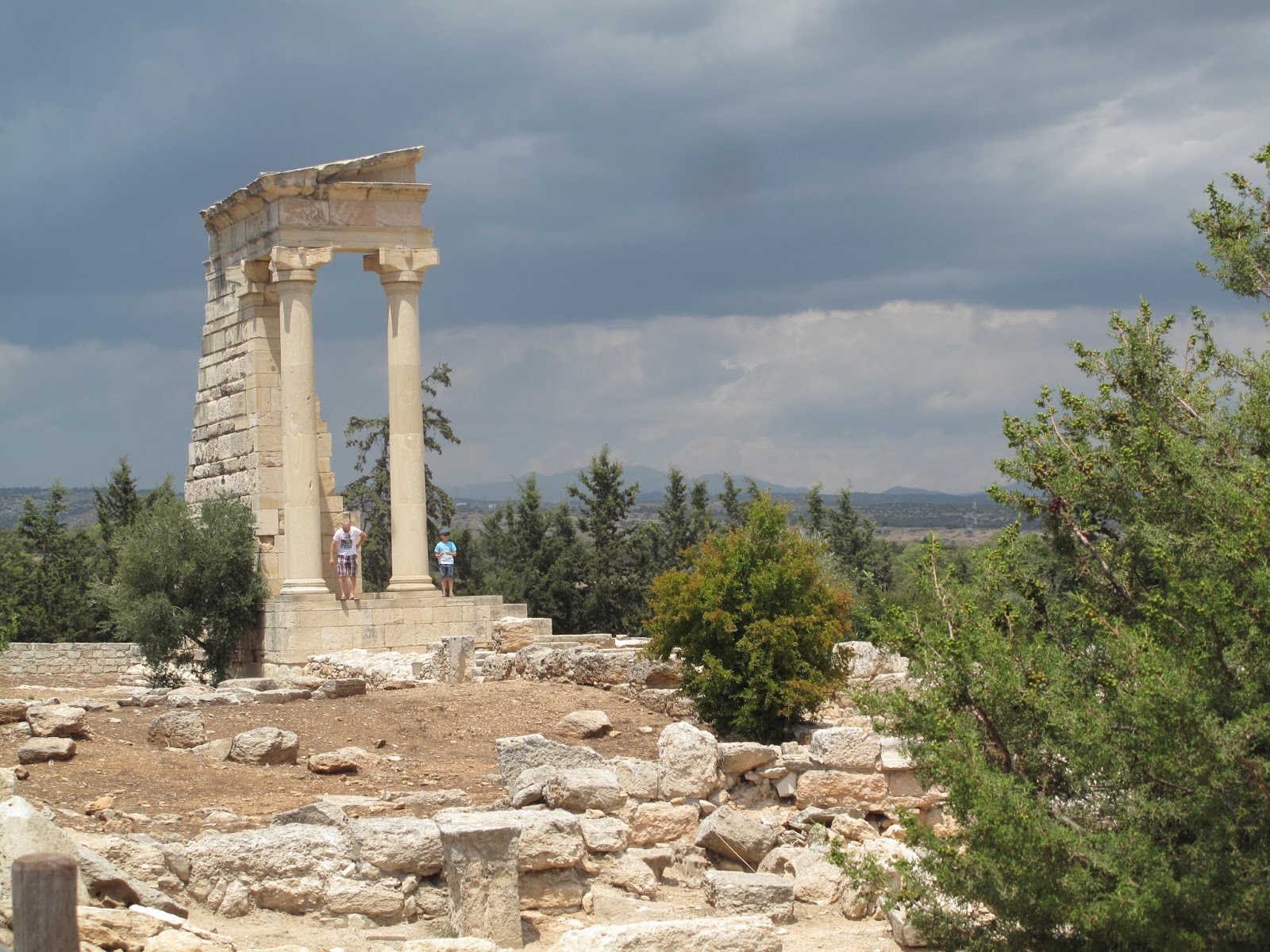
     Kourion has two other sectors to the west, with separate access: a stadium and the sanctuary of Apollo Hylattes.  We stopped at both.  Few visitors here, even though the Temple of Apollo, in particular, is very striking.


Temple of Apollo Hylattes, Kourion

        Late lunch just off the main highway leading westward toward Paphos.  I had an excellent tuna salad.  When people ask, as did the proprietor of this restaurant, I say I’m American and that I live in Turkey. This last fact has not caused any reaction, either positive or negative.
        Not far beyond, we left the highway again for Petra tou Romaiou, striking rock formations by the seashore associated with the birth of Aphrodite.  This spot, with a small pebbled beach, was crammed with tourists.  Water was expensive in the market/store, but the WC was clean (as they have been everywhere).


Petra tou Romaiou

     Clearly, a stop on day excursions – for Russians from Limassol?  On the sign in the window of one bus, the tour program also listed Kykkos, a famous monastery high in the Troodos Mountains.  Archbishop Makarios III, the first president of Cyprus, began his religious training there.  This comprehensive combination of beach/Aphrodite and mountains/Orthodox monastery/Virgin Mary sounded distinctly appealing.          
On to Kouklia/Palaiopaphos, in the modern, upscale town of Kouklia.  A major sanctuary of Aphrodite is here, but visible in ground plan only, typical for Cyprus – although there are some massive stone blocks/orthostats/ashlars from Late Bronze Age construction.


Kouklia/Palaeopaphos: Late Bronze Age construction

     Also here is a medieval “manor house”, originally from the Lusignan period, with later Ottoman refurbishing.  In the later Middle Ages, Kouklia was active in the lucrative cane sugar industry.  One hall has beautiful Gothic rib vaults. A chamber music concert was to take place there that evening.


Gothic hall: Lusignan period

Other rooms contained a collection of antiquities, including a surprising painted stone (or terracotta?) sarcophagus of Persian-period date.


At the end of the afternoon we drove on to Paphos – to upper Paphos, the town proper. Kato Paphos, the lower town on the seacoast, has been developed for mass tourism and is wall-to-wall bars and restaurants designed to appeal in particular to British tourists.
        Our hotel, the Axiothea, was beautifully sited on a bluff. Our room had a panoramic view of the seacoast, almost 180°.
The next morning we drove down to Kato Paphos to visit the extensive archaeological area. The main attraction: Roman houses with mosaic floors.


Two are preserved under permanent shelters, the House of Aion and the very large House of Dionysos.  A Polish team from Warsaw began excavating here in 1965.  A few days earlier we had seen a fine exhibit on their results in the Cyprus Museum in Nicosia.
        The site is enormous.  Because we had much more on our day’s program, we skipped the other sectors, such as the odeion and the agora.
        Back to the car (our rental Toyota, with right hand drive), for a short drive to the “Tombs of the Kings,” a necropolis featuring rock-cut tombs, especially multiple groups in the style of Alexandrian hypogea.


One of the underground “Tombs of the Kings” – Paphos

Next stop: Lemba, a Chalcolithic settlement with round houses of various sizes, with some reconstructions.  The biggest one had red painted decoration on the outside and inside, now faded since the initial reconstruction.  We were the only visitors here.


Lemba: a reconstructed house

After this, we headed northwest to see Maa-Palaikastro, a short-lived 12th c. BC settlement of Mycenaean refugees.  This site occupies a peninsula flanked by beaches with attractive hotels and houses.


The fortification wall is built of large blocks. The houses are preserved only in ground plan, but the area is littered with  potsherds.


Maa – Palaikastro

At the far end is the small Museum of Mycenaean Colonization of Cyprus, a round building that looks like a space ship sunken in the ground.


The exhibit, about the 13th-12th c. BC, was quite general, and unfortunately had little about the site itself.
        After this, we drove back to Nicosia without a stop.  It took only two hours. Thanks to precise directions received a few days before from a helpful man at the Larnaca Tourism Information Office, we found our parking lot by the Venetian walls without any difficulty.
        The next day we returned our rental car in the outlying district of Strovolos, paying a whopping penalty for a tiny nick in the paint; took a taxi back to the city center; toured Nicosia in the later morning; then, after lunch, took our bags and walked up Ledra Street to the crossing point into the northern sector. After a visit to the Selimiye Mosque, originally built in the 13th century as the St. Sophia church, a large, majestic Catholic church in the Gothic style, and an admiring look at the Gothic façade of the adjacent Bedesten, we took a taxi to the Ercan airport and a flight (Pegasus airlines) back to Ankara. 
     Looking forward to a return!

Bedesten (adjacent to the Selimiye Mosque), Nicosia